FDG RESULTS FOR NGC 2403
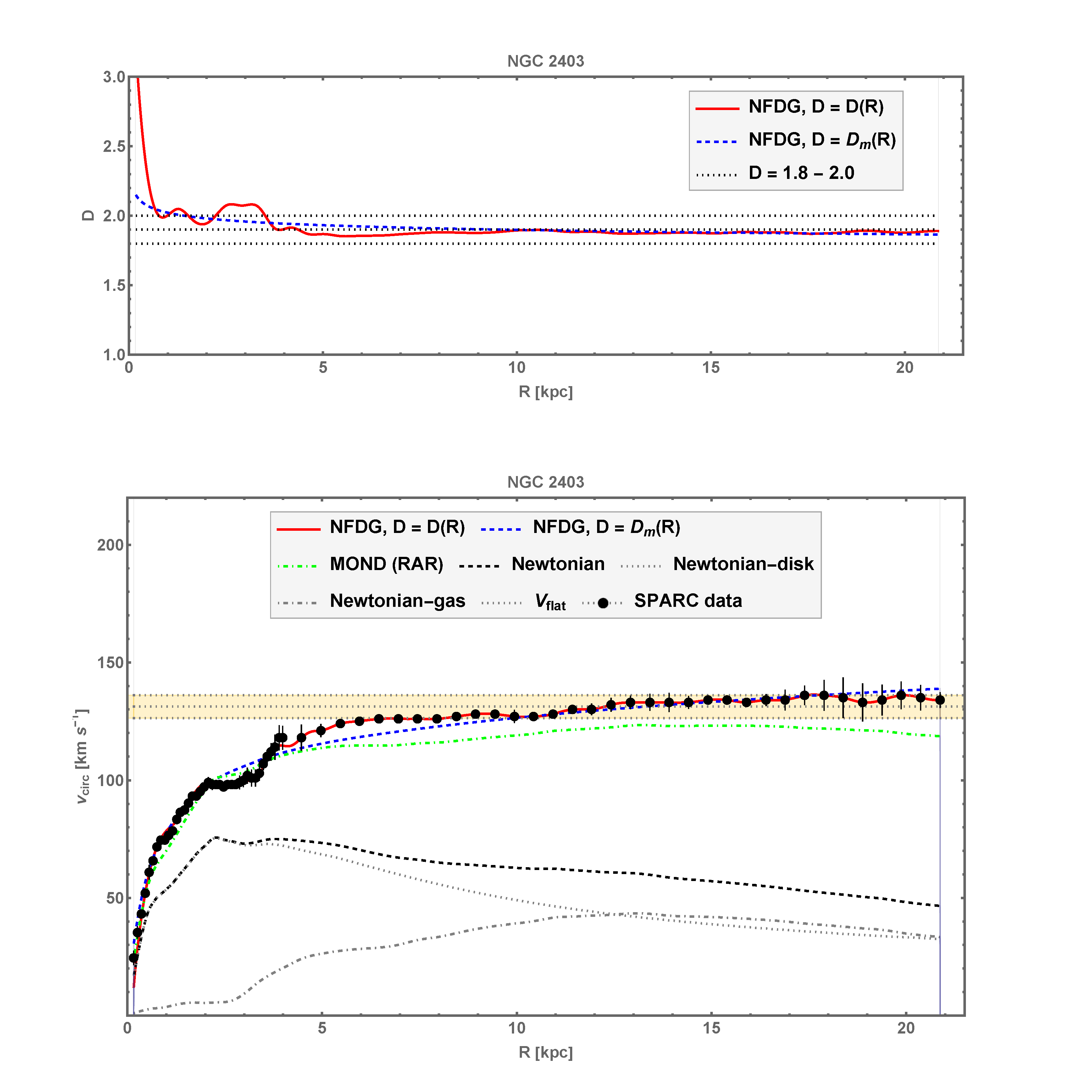
NGC 2403 is an intermediate spiral galaxy in the constellation Camelopardalis and approximately 8 million light-years away. This galaxy does not possess a central spherical bulge, but just stellar disk and gas components. NFDG results for NGC 2403 are described in the figure below: the top panel shows the variable dimension D(R) (red-solid curve) computed with the main NFDG model, and the new mass-dimension function Dm(R) (blue-dashed curve), computed with the NFDG field equation. Both dimensions are very close to values in the range D=1.8-2.0, over most of the radial range. This is typical NFDG behavior for galactic structures dominated by an axially-symmetric stellar disk component. Bottom panel: NFDG galactic rotation curves compared with SPARC data. There is perfect agreement between the main NFDG D(R) curve (red-solid) and the experimental data. This shows that, if this galaxy behaves as a fractal structure whose dimension D follows the red-solid curve in the top panel, then the resulting NFDG circular velocity curve in the bottom panel (red-solid) will perfectly fit the experimental data, without any need of dark matter. The NFDG Dm(R) curve (blue-dashed) is less effective in fitting the experimental data, but still captures the overall trend of the data.
A disk-dominated galaxy, such as NGC 2403, is characterized by a fractional dimension which is very close to D=2. This is due to the axially-symmetric, flattened-disk shape of this galaxy (see also similar galaxies NGC 3198 and NGC 6503). The gas component is less important for this galaxy. NFDG computations for this galaxy were performed by Mr. Isaiah Tyler, LMU senior physics student (2025).