FDG RESULTS FOR NGC 6946
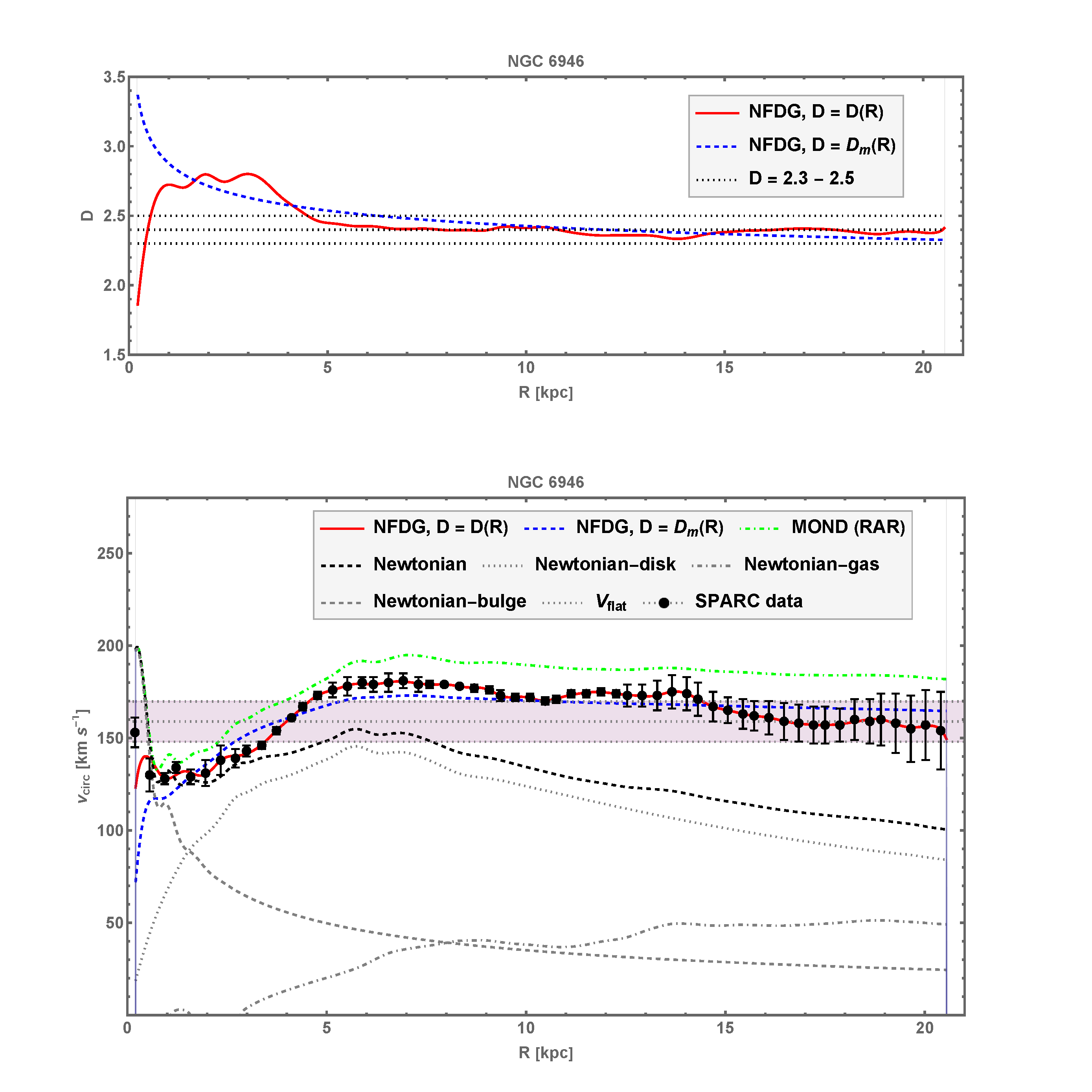
NGC 6946 is a bulge-dominated intermediate spiral galaxy in the Virgo Supercluster, approximately 25 million light-years away. This galaxy is sometimes called the "Fireworks Galaxy" due to its face-on aspect, prominent and continuous spiral arms. It has a small bright central nucleus, surrounded by a strong stellar disk and gas components extending outward in space. NFDG results for NGC 6946 are described in the figure below: the top panel shows the variable dimension D(R) (red-solid curve) computed with the main NFDG model, and the new mass-dimension function Dm(R) (blue-dashed curve), computed with the NFDG field equation. Both dimensions decrease from D=2.8-3.0 at smaller radial distances to D=2.3-2.4 at larger distances. This is typical NFDG behavior for galactic structures dominated by a spherically-symmetric component, such as the galactic bulge. Bottom panel: NFDG galactic rotation curves compared with SPARC data. There is perfect agreement between the main NFDG D(R) curve (red-solid) and the experimental data. This shows that, if this galaxy behaves as a fractal structure whose dimension D follows the red-solid curve in the top panel, then the resulting NFDG circular velocity curve in the bottom panel (red-solid) will perfectly fit the experimental data, without any need of dark matter. The NFDG Dm(R) curve (blue-dashed) is less effective in fitting the experimental data, but is still a remarkably good fit.
A bulge-dominated galaxy, such as NGC 6946, is characterized by a fractional dimension which is larger than the D=2 value that we observed for a disk-dominated galaxy, such as NGC 6503. This is due to the spherical symmetry of the dominating bulge component (see also similar galaxy NGC 7814). The gas component is even less important in this case. See my seventh paper for a full discussion of this galaxy.